

This text has been translated by a machine and has not been reviewed by a human yet. Apologies for any errors or approximations – do not hesitate to send us a message if you spot some!
The Maastricht Treaty, which entered into force in 1993, established the European Union and created, alongside the internal market, an economic and monetary union. This union is based, in part, on the coordination of the economic policies of EU countries1 and, on the other hand, on the creation of a single currency, the euro, which came into effect in 1999.
The treaty also establishes several fundamental principles for the monetary policy of all EU countries: the independence of central banks, the primary objective of combating inflation, and a prohibition on lending to governments (or other public institutions). For the countries of the eurozone, which will comprise 21 member states in 20262, monetary policy as a whole is now implemented by joint governance bodies (see box).
This fact sheet analyzes the monetary policy implemented in the euro area since its creation. In particular, it shows how the crises the EU has faced over the past two decades have led to significant shifts in policy objectives—with financial stability taking on greater importance and climate issues coming to the fore—as well as in the tools used to implement monetary policy. Since 2022, however, this window of opportunity appears to have closed: the current implementation of monetary policy transfers income to banks and makes no distinction between fossil-fuel and low-carbon investments.
ECB, ESCB, Eurosystem: Understanding the Monetary Policy Governance Bodies in the European Union
The European Treaties3 have established three governing bodies for the European Union’s monetary policy.
- The European System of Central Banks (ESCB) comprises the European Central Bank and the national central banks (NCBs) of the EU member states;
- The European Central Bank (ECB), established by the treaties, is a legal entity independent of the member states;
- The Eurosystem comprises the ECB and the NCBs of the euro area countries.
According to the treaties,“the ESCB is governed by the decision-making bodies of the ECB”:
- The Governing Council sets the European Union’s monetary policy and takes the decisions necessary to fulfill the tasks entrusted to the ESCB by the Treaties. Composed of the ECB’s Executive Board and the governors of the NCBs of the euro area countries, it meets at least 10 times a year.
- The Executive Board implements monetary policy in accordance with the guidelines and decisions adopted by the Governing Council and issues the necessary instructions to the national central banks. It consists of six members (including the President of the ECB), who are appointed by the European Council for a term of eight years.
Within the eurozone, therefore, the ECB’s Governing Council makes the decisions, and the national central banks implement them in their respective countries under the guidance of the Executive Board.
In countries that are not members of the euro area, the NCBs must adhere to a number of key principles (including monetary policy objectives and their independence), but they retain the authority to conduct their country’s monetary policy.
Background on the Monetary System and Money Creation
To understand the topic discussed in this fact sheet, it is necessary to have a basic understanding of how the monetary system is organized and how money is created.
Understanding the different roles and powers of the actors involved in the monetary system, as well as the different types of money
The monetary system is a hierarchical system comprising several levels, each involving different participants and in which different currencies circulate. The following description reflects how most modern economies function.
At the bottom of the monetary pyramid, economic agents are solely users of money
Households, businesses, nonbank financial institutions, and—in some countries, such as Germany—local governments have accounts at banks. The government (and, in some countries, such as France, other public administrations) has an account with the Treasury.
All of these actors exchange goods and services and pay wages and taxes using the money in their accounts (book money) or banknotes (fiat money).
At the next level are commercial banks, which create book money, and the Treasury
Banks hold the accounts of economic agents. When they extend credit, they create book money (the money recorded in accounts) and destroy it when the loans are repaid. A bank can go bankrupt, which has happened many times throughout history. The money recorded in the accounts of the affected bank’s customers then disappears.
The Treasury manages the government’s account and, in some countries (such as France), the accounts of other public agencies. It is sometimes called “the State Bank,” but this is inaccurate in most countries, since it does not have the power to create money and is therefore not a bank.
Banks and the Treasury maintain accounts at the Central Bank. The only currency circulating among these entities is central bank money.
At the top of the pyramid, the Central Bank (CB) is the cornerstone of the system
The Central Bank is responsible for monetary policy (see Part 2) and for supervising commercial banks.
Unlike commercial banks, a central bank cannot go bankrupt. It can, however, lose credibility, which results in a decline in the value of the currency it is responsible for relative to the currencies of other countries.
The Central Bank is sometimes called the “bank of banks” because it holds the accounts of commercial banks and the Treasury.
It creates central bank money, which is recorded in the accounts of banks and the Treasury: this is the only money that circulates among these three categories of economic agents.
It also creates banknotes, known as fiat money, which circulate among economic agents (households, businesses, etc.).
In the current monetary system, there are therefore three different types of money
- Central bank money (also known as reserves or bank liquidity) circulates only among the central bank, commercial banks, and the Treasury.
However, this is not an immutable rule: while central banks in many countries are currently prohibited from lending directly to the government, this has not always been the case; furthermore, the creation of a digital euro could lead to the central bank crediting households’ accounts directly.
- Book money (created by banks) and fiat money (banknotes created by the central bank and distributed by banks) circulate among economic agents when they exchange goods and services.
Banks create money, but this power is not unlimited
Banks have been granted the authority by the government to create book money. They do so through a simple accounting entry.
Banks create book money through an accounting entry
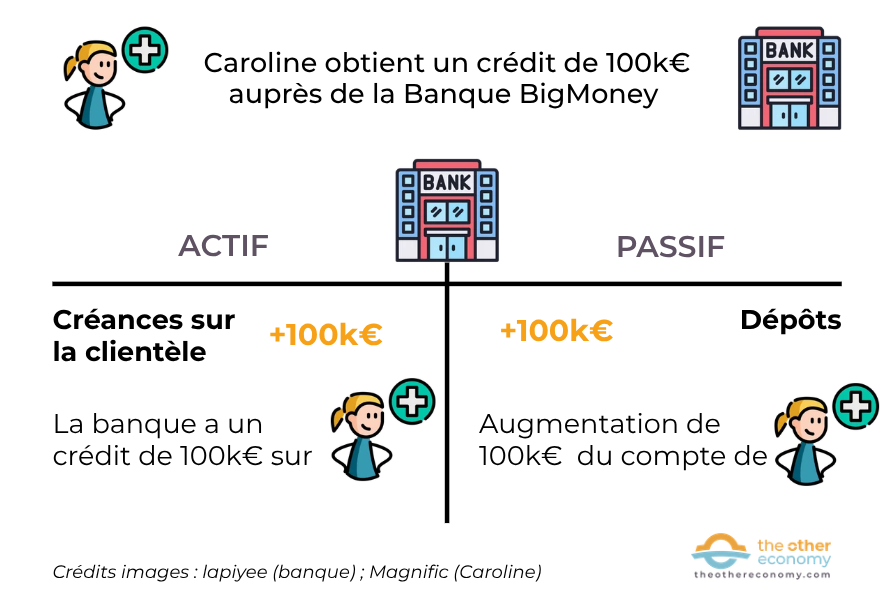
When the red bank grants Caroline a €100k loan, here’s what it records on its balance sheet4 :
- On the asset side, a receivable in this amount (Caroline owes the bank 100k€)
- On the liabilities side, an increase in deposits of €100k (Caroline’s account is credited with €100k, so the bank owes this amount to Caroline).
Learn more in the module on money
Banks’ power to create money is not unlimited.
- An economic agent must apply for a loan from the bank.
- The banker must ensure that the borrower will be able to repay the loan; otherwise, this could result in losses that, if too high, could lead the bank to bankruptcy. To ensure greater security, governments have established what are known as prudential rules. These rules are designed to ensure that banks have enough capital to absorb losses and enough liquidity to handle large withdrawals of book money or cash by their customers.
- If a bank does not have enough central bank money to meet its obligations (see box), it must borrow it from its central bank or from other banks on the interbank market5, which (theoretically) comes at a cost.
Why do banks need central bank money?
1. To comply with regulatory reserve requirements.
In almost all currency areas, the law sets a certain level of so-called required reserves that banks must maintain in their accounts at the central bank. The amount is calculated as a percentage of the deposits listed on the liability side of banks’ balance sheets. If a bank’s deposits increase due to money creation, then the amount of these required reserves also increases.
2/ Meeting customer requests for cash withdrawals.
Banknotes account for about 14% of the money in circulation6 in the eurozone. When the money supply increases, customer demand for banknotes (i.e., ATM withdrawals) also increases. When a bank’s deposits increase, it must therefore purchase banknotes from the Central Bank. And to do so, it needs central bank money.
3/ Settle their accounts with one another.
If there were only one bank, the millions of daily transactions carried out among its customers would take the form of transfers between accounts held at that single bank: there would be no “outflow” of money to other banks. Since this scenario is, of course, hypothetical, when we calculate the balance7 of the millions of transactions carried out each day among all economic agents, some banks find themselves in debt to others. They then need central bank money to pay what they owe.
Beyond inflation, the expansion of the ECB’s mandates
In the eurozone, the European Central Bank (ECB) is responsible for conducting monetary policy (see the box at the beginning of this article).
His main mandate8 is to“maintain price stability.” It also has a secondary objective: to support “general economic policies in the Union, with a view to contributing to the achievement of the Union’s objectives, as defined in Article 3 of the Treaty on European Union”, but this objective is only taken into account provided that inflation is under control.
As we will see, while the goal of price stability has always remained the top priority, the monetary policy tools used to achieve it have evolved in response to multiple crises. In addition, other issues—such as financial stability, preserving the eurozone (and thus guaranteeing member states’ debt), and combating climate change—have emerged.
Price stability remains the primary objective
Until the 2007–2008 financial crisis, the eurozone’s monetary policy focused exclusively on “price stability.” Since the specific objective was not enshrined in the treaties, it was the ECB that defined and quantified it.
Under the stability-oriented monetary policy strategy (1998), the inflation target (measured by the HICP) must be below 2%. This objective has evolved slightly since then: it is now understood that inflation should converge toward 2% (rather than simply remaining below it)9. The tools used to achieve this goal have evolved significantly over the period.
Until 2008, the primary tool was the key interest rate—that is, the interest rate at which the ECB lends central bank money to commercial banks (see the box in Section 3.1 for more details).
How do the ECB’s decisions on the key interest rate affect inflation?
Central banks highlight several transmission channels linking their policy rate decisions to their effects on economic activity and inflation. The most important of these is the interest rate channel.10
The cheaper the central bank’s money, the more commercial banks can extend low-cost credit to economic actors, which stimulates economic activity and accelerates inflation; conversely, expensive central bank money leads banks to restrict credit (by raising the rates at which they lend to their customers), which depresses economic activity11 and reduces inflation.
It should be noted that this is an asymmetric tool: it works better at curbing economic activity than at stimulating it12 as was clearly demonstrated in the 2010s, when the policy rate became ineffective. Furthermore, it is a rather crude tool to use (it makes no distinction between different sectors; see Section 4).
Source
The 2007–2008 financial crisis marked the beginning of a period of very low inflation or even near-deflation.13
Growth Rates and Inflation in the Eurozone
Since its creation, the eurozone has weathered numerous economic crises with a variety of causes (financial crises, the sovereign debt crisis, COVID, the energy crisis), which have led to significant fluctuations in inflation.14
Inflation and Growth in the Eurozone Between 1999 and 2025
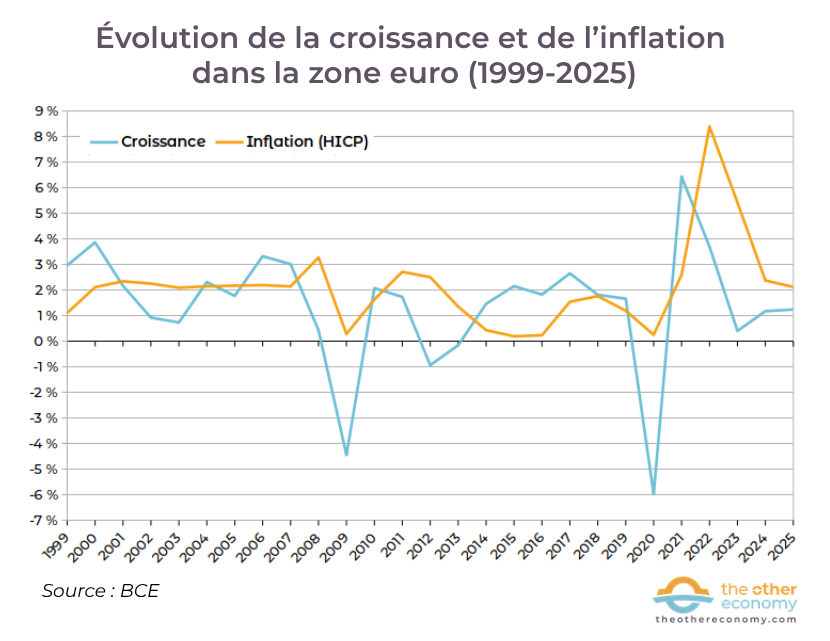
Inflation is measured using the HICP (Harmonized Index of Consumer Prices).
Source: European Central Bank (growth rates, inflation)
This situation has several consequences.
- The policy rate tool becomes ineffective: after being steadily lowered until it reached 0% in 2016, it proves insufficient to stimulate economic activity and inflation. The ECB then introduced new “unconventional” tools: long-term loans at very low interest rates for banks, and quantitative easing, which involves purchasing government debt securities from banks (see Section 3.2).
- Other monetary policy objectives can be pursued because they are viewed as consistent (or not contradictory) with the goal of price stability. These include, in particular, safeguarding the eurozone and climate policy.
With the return of inflation in 2022, the key interest rate has been reaffirmed as the ECB’s primary tool, and unconventional tools are gradually being phased out.
The financial crisis has brought the issue of financial stability back to the forefront of central banks’ mandates
This major historical function of central banks had been delegated to independent regulatory authorities. The prevailing consensus at the time was that price stability was sufficient to ensure financial stability15, a view that was largely disproved by the financial crisis.
This function is twofold.
On the one hand, it involves central banks taking corrective action as lenders of last resort16. This is what happened during the financial crisis and the COVID crisis: central banks injected massive amounts of liquidity very quickly into the banking system to prevent it from collapsing.
Another key role is to play a preventive role by monitoring and supervising banks to ensure they have sufficient capital and liquidity to weather a financial crisis. The establishment of the Single Supervisory Mechanism (SSM) in 201417 explicitly incorporated financial stability into the ECB’s mandate. It is now responsible for the direct supervision of the largest banks in the euro area (including the seven systemic banks18); national supervisory authorities19 are responsible for overseeing smaller banks.
The Eurosystem Comes to the Rescue of the Eurozone
In the wake of the 2007–2008 financial crisis, public debt skyrocketed across Europe as a result of measures taken to support the financial sector and the operation of automatic stabilizers20 and the 2009 stimulus plans. Starting in 2010, interest rates on Greek public debt skyrocketed21, soon followed by those of Ireland, Portugal, Spain, and Italy. They reached levels so high that these countries could no longer finance themselves on the capital markets.
The ECB initially refused to intervene, citing its statutory prohibition against lending to governments. As this situation threatened the eurozone as a whole, ECB President Mario Draghi changed his stance. In July 2012, he stated: “The ECB is willing to do whatever it takes to preserve the euro, and believe me, that will be enough.” and launched a program to buy back bonds from troubled countries, which brought borrowing costs back down. In early 2015, it went a step further by launching the first program to quantitative easing22. In 2020, a second program was launched to address the economic consequences of the COVID-19 pandemic and the lockdowns.
These various programs have helped keep the interest rates at which governments borrow very low. In practical terms, this means that the central banks of the Eurosystem are fulfilling their role as lenders of last resort to eurozone countries.
Starting in 2022, if the return of inflation leads to a gradual phasing out of quantitative easing (See Section 3.3), a permanent response mechanism has nevertheless been established. This is the Transmission Protection Instrument (TPI), established in July 2022, which allows for the purchase of sovereign debt on the secondary market “to counter unjustified and disorderly market dynamics that pose a serious threat to the transmission of monetary policy throughout the euro area”. The activation of the TPI is subject to a number of conditions, including, in particular, that the relevant country complies with the European fiscal framework.23
Starting in 2015, climate change became a topic of concern for central bankers
In his famous speech on the “tragedy of horizons” (2015), Mark Carney, then governor of the Bank of England, told an audience of financial professionals gathered at Lloyds that global warming poses systemic risks to financial stability.
This speech marked the beginning of a shift in awareness: the issue of climate change, which had previously been a marginal topic, became a recurring theme in central bankers’ remarks24. In 2017, the NGFS was established: it is a network of central banks aimed at contributing to the assessment and management of climate-related risks to financial stability, as well as to the greening of the financial system.
Beyond rhetoric, central bankers’ actions have focused primarily on risk assessment rather than on monetary policy tools that would help channel financing toward climate investments.25
This is also true of the ECB.
Since the release in 2021 of the first action plan to incorporate climate change considerations into its monetary policy strategy26, the ECB has developed several types of activities.
- Managing climate-related risks: The ECB assesses and models climate risks for the Eurosystem (scenarios, stress tests) and requires the banks it supervises to do the same, going so far as to impose fines on them starting in 202527. The ECB also publishes statistics on climate change indicators.28
- Assessment of Risks Related to Nature: Starting in 2023, the ECB began assessing the exposure of euro area economies to risks related to the degradation of nature and ecosystem services29. This is one of the priority areas of the 2024–2025 Nature and Climate Plan.
- Reducing the impact of its activities and improving transparency: since 2022, the Eurosystem has published a report on the carbon content of its securities portfolio30, development of a strategy to limit its environmental impact (its facilities, employee commuting, energy, etc.)31, conducting a study on the environmental footprint of euro banknotes as a means of payment (2023).
- Finally, in 2022, the ECB also announced32 that it would incorporate climate considerations into its monetary policy operations. As we will see in Section 4.2.3, however, these commitments have had little impact to date, given that they pertain to monetary policy tools (quantitative easing and loans to banks) that are being used less and less.
The Three Phases of the Eurozone’s Monetary Policy
An analysis of the Eurosystem’s balance sheet assets reveals three major phases of Eurosystem monetary policy since the introduction of the euro.
The Three Major Phases of the Eurosystem’s Monetary Policy
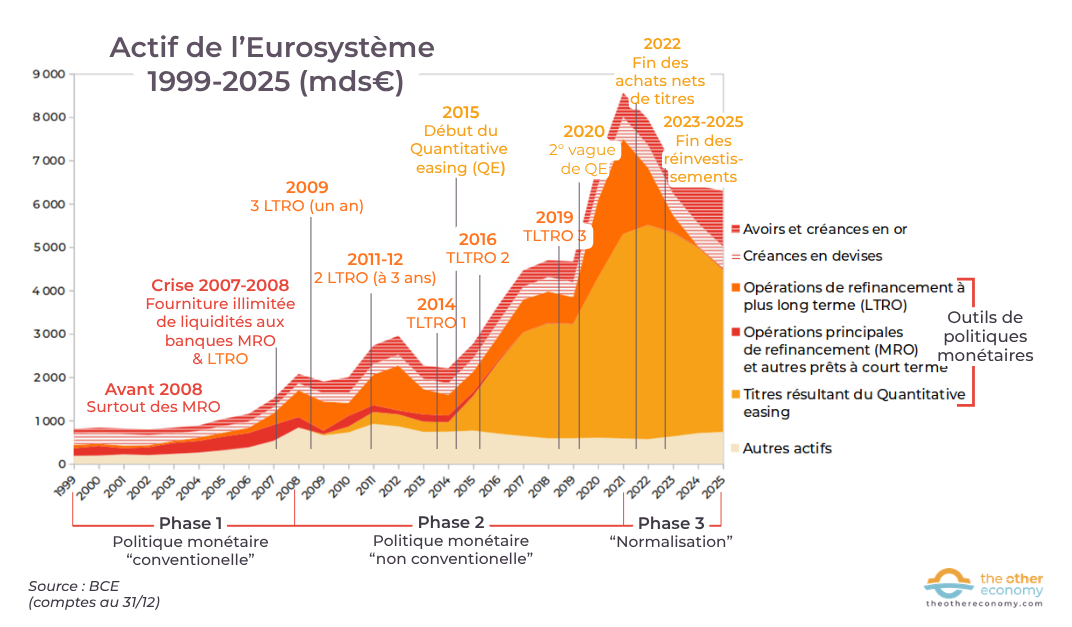
A balance sheet is an accounting document that provides a snapshot at a given point in time (usually at the end of the year) of what an organization owns (assets) and what it owes (liabilities). On the Eurosystem’s asset side, for example, one can see the amount of its gold reserves, (outstanding) loans granted by the ECB and the NCBs to banks, and financial securities they have acquired.
From the creation of the euro area to the 2008 crisis, the main tool of “conventional” monetary policy was the policy rate
In the early days of the eurozone, banks needed to borrow central bank money regularly from the central banks of the Eurosystem (they are said to “refinance” with the central bank). The main monetary policy tool is the ECB’s key interest rate, which sets the cost of these loans for banks.
The most common loans at this time are main refinancing operations. They operate on an auction basis. Every Tuesday, the NCBs auction central bank money for a one-week term. Banks bid by specifying the amount of central bank money they need and offering an interest rate that must be higher than the ECB’s policy rate.
Banks that have borrowed central bank money temporarily pledge financial securities (called “collateral”) to the central bank as security. This “collateral” must meet minimum (financial) quality criteria, such as a satisfactory rating from credit rating agencies.
There are two other types of loans: the marginal lending facility (an emergency loan for 24 hours) and longer-term refinancing operations (loans with a 3-month term).
The European Central Bank sets three key interest rates
- The main refinancing rate is the rate used for main refinancing operations (one-week central bank loans). It was the primary monetary policy tool prior to 2008.
- The marginal lending facility rate applies to emergency loans (24 hours). It is higher than the main refinancing rate.
- The deposit facility rate is the interest received (or the cost incurred during periods of negative interest rates) by banks when they have excess central bank money and deposit it for 24 hours in their account with the ECB. It has been the main policy rate used for monetary policy since 2008.
See the Banque de France’s educational fact sheet on key interest rates and their trends on the ECB’s website
From 2008 to 2022, “unconventional” monetary policy: providing massive amounts of liquidity to banks
With the 2007–2008 financial crisis, the ECB initially opened the floodgates to refinancing operations. This mechanism, which had previously involved auctions every Tuesday, is now unrestricted: loans are granted on demand at an increasingly low rate. The main refinancing rate fell from 4.25% in July 2008 to 0% in March 2016.
This proved insufficient to cope with the succession of crises (the 2009 recession; the 2010–2012 sovereign debt crisis) and inflation that consistently remained below 2% (and even approached deflation in 2014–2016), the ECB then implemented monetary policies known as “unconventional” or “accommodative,” which involved providing massive amounts of liquidity to banks through new tools.
- Longer-term refinancing operations (loans with a maturity of more than one year)33 are gradually replacing the main refinancing operations (one-week loans). Starting in 2014, these operations have been referred to as “targeted” because the ECB lends to banks based on the volume of loans the banks themselves have extended to businesses and households. The interest rates on these loans are very favorable—sometimes even negative in the case of targeted operations34 (the central bank pays banks when it lends to them).
- Massive debt purchase programs (primarily government debt), known as “quantitative easing”(QE), by the central banks of the Eurosystem. Launched in May 2010, the first of these programs35 remained limited. It was not until 2015 that large-scale QE began36, which was further expanded in 202037 in response to the crisis caused by the COVID-19 pandemic.
These policies have a significantly greater impact on the economy than the benchmark interest rate alone. They give banks unlimited and free access to central bank money (used to purchase debt securities). This therefore removes this obstacle to lending. This effect, however, has proven to be fairly limited. Demand for credit from households and businesses does not depend solely on its price. Many other factors play a role, such as the financial situation of borrowers (income and debt levels) or confidence in the future (business order books, the state of the labor market, etc.).
QE also has a very significant impact on the bond market (the market for debt securities). Interest rates on government bonds, in particular, have been driven down and have even turned negative at times, making it easy to finance government deficits at low cost throughout this period. For more details on the impacts of quantitative easing, see our dedicated article.
From 2022 to 2026: the “normalization” of monetary policy
Starting in late 2021, the eurozone has experienced a very sharp spike in inflation, driven in particular by disruptions in global supply chains38 caused by lockdowns in China, the strong post-COVID-19 economic recovery, and, above all, the impact of the invasion of Ukraine on energy and agricultural prices.
The time has come for the “normalization” of monetary policy, which in practice amounts to a largely restrictive policy.
It is ending its unconventional policies. Most long-term loans mature at the end of 2023, and no new operations are being launched. It also announced the gradual phasing out of quantitative easing: starting in mid-2022, it will end net purchases of financial securities39. A year later, it reduces the level of reinvestments (i.e., the purchase of new assets to replace those maturing), which will cease entirely on January1, 2025.40
At the same time, the policy rate tool—which had been ineffective in the previous phase—returned to prominence. The ECB raised its policy rates 10 times between July 2022 and September 2023. The main refinancing rate thus rose from 0% to 4.5%. However, this is no longer the primary tool used to influence banks’ behavior. As we will see in the next section, banks now have abundant liquidity and no longer need to borrow central bank money from the ECB. Instead, the deposit facility rate is used: banks earn interest when they hold their central bank money in their accounts at the ECB, which discourages them from lending at a rate lower than this interest rate.
Starting in June 2024, the ECB cuts its key interest rates in response to falling inflation, before raising them again in June and then September 2026 in response to a new surge in inflation caused by the closure of the Strait of Hormuz.
What Will Monetary Policy Look Like in 2026?
Monetary normalization policy involves reaffirming the primacy of the monetary policy tools used prior to 2008. This is evident, for example, in the Monetary Policy Decision of December 15, 2022.
“The ECB’s key interest rates are the Governing Council’s main instrument for setting the direction of our monetary policy.”
It also involves “normalizing” the Eurosystem’s balance sheet—that is, gradually reducing its size41. That said, there is no basis for determining—let alone justifying—what this “normal” size actually is.42
While the monetary tools used before 2008 appear to have made a comeback, we will see that the situation has changed profoundly—in particular because it is now significantly more favorable to banks. This situation is the result of choices that are not dictated by economic laws, and it is important to question them in light of the very objective of monetary policy—price stability—but also, and more importantly, to promote investments in the ecological transition.
The current monetary policy is more beneficial to banks than it was before 2008
Banks have considerable liquidity
Before 2008, since banks held relatively little liquidity, they regularly needed to refinance (borrow) from the ECB (or on the interbank market) to meet their central bank money needs. This refinancing generally came at a cost close to the main refinancing rate, which was therefore the primary tool of monetary policy. When the ECB wanted to curb lending activity in response to inflationary pressures, it raised this rate and thus the cost to banks.
Unconventional policies have profoundly changed the situation.
Banks now structurally hold a very large amount of liquidity in central bank money. The amounts involved are considerable: banks’ liquidity held with the Eurosystem peaked at around 4,300 billion in 202143 and have been gradually declining as the Eurosystem’s balance sheet “normalizes”44 (3,000 billion euros at the end of 2024, 2,600 billion euros at the end of 2025, and just over 2,000 billion euros at the end of August 202645).
Changes in Eurosystem liabilities and bank liquidity held with central banks
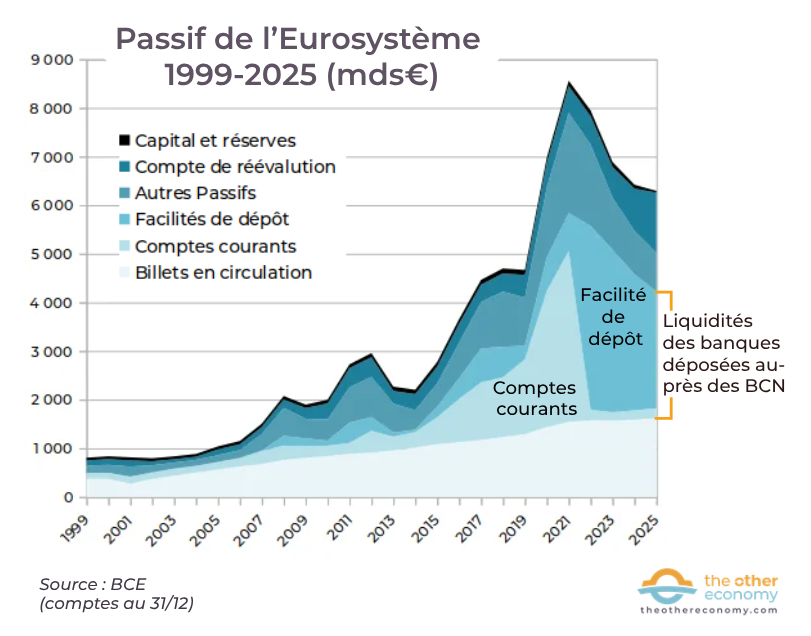
Source: Eurosystem Annual Consolidated Balance Sheet
Banks’ liquid assets are deposited with the national central banks of the Eurosystem in two ways.
- Checking accounts: Banks must maintain a minimum balance in these accounts, known as required reserves46 and may also deposit excess reserves (beyond the required reserves) into these accounts. Required reserves have not earned interest since September 202347. Excess reserves have earned interest since June 202648 at the deposit facility rate.
- The Ease of Filing : Banks can deposit their excess liquidity there on an overnight basis. They hold the funds until the following morning and earn daily interest based on the deposit facility rate. From June 2013 to July 2022, this rate was negative: banks therefore had to pay the Central Bank to deposit their excess liquidity in the deposit facility, which is consequently rarely used. Starting in September 2022, the ECB decided to return this key rate to positive territory. This triggered a massive transfer of funds from the banks’ current accounts to the deposit facility.
With massive amounts of liquidity at their disposal, banks have significantly less need to refinance with their central bank
This is evident from the statistics on refinancing operations in the table below: refinancing operations prior to 2008 were significantly larger than those after 2022, even though the eurozone has expanded in the meantime. Since key interest rates were relatively similar in both periods, they do not explain this difference.
Banks in the eurozone no longer need to borrow from their central bank
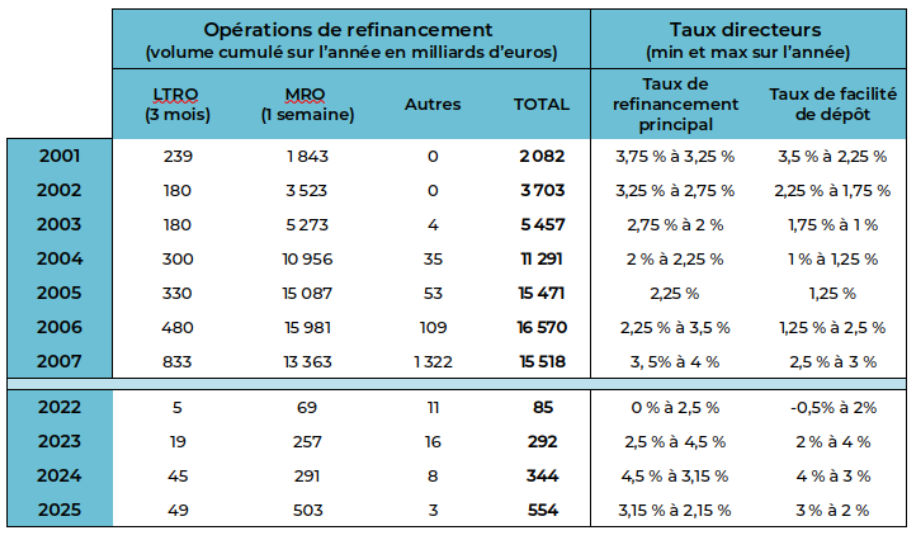
Reading: In 2006, cumulative refinancing operations49 of banks by the Eurosystem totaled 16,570 billion euros. That year, the main refinancing rate rose from 3.5% to 4% (there was an interim rate increase that is not shown in the table).
Notes: MRO (main refinancing operation): main refinancing operation > these are one-week loans from the Central Bank; LTRO (long-term refinancing operation): long-term refinancing operation > three-month loans.
Source: Eurosystem refinancing operations—historical data since 1999, available for download on the Banque de France website, and key interest rates on the ECB website.
Banks are paid for not using their liquidity
Under the pre-2008 system, when the ECB wanted to curb inflation, it raised the main refinancing rate, which led to higher costs for banks. Banks would pass on this increase to the interest rates they charged businesses and households for loans, which in turn led to a slowdown in economic activity.
Today, since banks have little need to refinance with their central bank, this tool is no longer truly effective. Consequently, the deposit facility rate has become the primary tool. This reality was formalized in the March 2024 Amendments to the Operational Framework for the Implementation of Monetary Policy.50
From now on, when the ECB raises its key interest rates, banks immediately benefit from higher interest on their deposits with the Eurosystem: this represents a massive yet largely invisible transfer to the banking sector51. At the peak of this trend, in 2023, interest paid to credit institutions exceeded €120 billion, according to the European Parliament52. Even today, these payments still amount to around €50 billion per year.
Furthermore, their impact on interest rates for economic actors is no longer a cost but a loss of revenue. That’s a significant difference!
The new monetary policy guidelines impose a cost on public finances
The remuneration of banks’ reserves has resulted in losses for the central banks of the Eurosystem53. As a result, these central banks were unable to pay dividends to member states, as they normally do when they are profitable. This mechanism is therefore less visible than direct budgetary spending, but it can have a comparable economic effect.
Furthermore, the end of quantitative easing is changing the government debt market. During QE, the Eurosystem was the primary buyer of government securities; it is now a net seller, since it no longer replaces maturing securities. Private investors, who are more risk-sensitive, must now absorb both new issuances and the securities that the Central Bank no longer reinvests. Combined with rising key interest rates and high levels of public debt, this quantitative tightening is pushing long-term rates higher and reigniting the issue of yield spreads between countries. The interest burden increases as public debt is refinanced, and theA snowball effect threatens as soon as the apparent interest rate exceeds nominal growth.
Other monetary policy options are possible and necessary
In summary, it can be said that the ECB has implemented a system that enriches banks at the expense of governments, with the aim of forcing banks to charge higher interest rates on loans in order to slow economic activity and reduce inflation. This policy was effective in terms of the price stability objective, since, following the peak in 2022, inflation returned to close to 2% by late 2024–2025. Unfortunately, the closure of the Strait of Hormuz following the U.S. and Israeli attack on Iran has triggered new inflationary pressures and, consequently, further interest rate hikes. This situation warrants several observations.
The interest paid on funds deposited by banks is a choice made in implementing monetary policy, not an economic law or an inevitable accounting consequence
For example, it would be possible not to pay interest on all bank liquidity. Between October 2019 and September 2022, the deposit facility rate was negative: banks therefore had to pay the central bank to deposit their reserves into their accounts. The ECB then implemented a two-tier system that exempted a portion of the reserves from the negative rate. Such a system could be reactivated in the opposite direction: paying the full rate on only a portion of excess liquidity and applying a lower rate—or even zero—to the remainder. Several stakeholders54 are now advocating this approach in order to limit extraordinary transfers to banks. Another option could be to raise the level of required reserves (which do not earn interest).
Finally, another approach would be to leave the interest rate at the deposit facility rate but to recoup part of the transfer through a specific tax on bank profits. Several European countries (Spain, Lithuania, the Czech Republic, Italy, and Hungary)55 have, in fact, experimented with or considered one-time levies on bank profits when rising interest rates significantly increased their margins.
The ECB’s monetary policy is counterproductive with regard to its price stability objective
The resurgence of inflation since 2021 is essentially an imported phenomenon. While monetary tightening policies may prove effective in the short term, they do not address the root causes: dependence on fossil fuel imports, the influence of global food prices, and dependence on globalized supply chains.56
Worse still, high-ranking members of the ECB themselves rightly acknowledge the link between inflation and dependence on fossil fuels.57
Given this situation, the ECB’s current policy could come at the expense of the medium-term price stability objective, as the Avant Garde Institute explains very clearly in a report commissioned by the European Parliament.58
By raising interest rates across the board, the ECB is penalizing investments in renewable energy and cleantech—investments that would reduce the eurozone’s structural exposure to precisely this type of shock. The ECB must therefore demonstrate that the decisions it is making today do not jeopardize price stability in the medium and long term by preventing the European economy from becoming more resilient to future fossil-fuel-related price shocks.
This is one of the characteristics of how the key interest rate is used in the eurozone. It is used solely to make credit more or less accessible to businesses or households. However, it has no influence whatsoever on the allocation of credit: a rise or fall in the rate affects all sectors of the economy and all regions. A rate hike will increase the cost of credit for real estate, renewable energy, and any other economic activity. Moreover, this effect is all the more pronounced in sectors that require significant initial investment and are capital-intensive—which is the case for most ecological transition projects.59
The Limitations of Monetary Policy on Climate Change
As discussed in Section 2.4, since the early 2020s, the ECB has implemented an action plan to integrate climate-related issues. While most of the measures implemented so far have focused on reporting and risk assessment, the ECB nevertheless announced in July 202260 that it would integrate climate considerations into its monetary policy. This involves two types of measures.
Increase the proportion of assets from companies with “good climate performance” on its balance sheet.
Given that quantitative easing operations have ended, this measure has no real impact, however. Furthermore, it does not apply to entities that do not issue debt on the bond markets and are financed primarily through bank credit (which accounts for a significant portion of transition projects). It should be noted, however, that this tool would benefit from being strengthened: if the ECB were to resume its asset purchases, it could reserve them for “green” securities (sovereign green bonds, EIB securities, or NextGenerationEU securities financing the transition).
Adapt its guarantee system to account for climate risks.
As stated in the Section 3.1, banks that borrow from the ECB must temporarily transfer financial securities (known as “collateral”) to the ECB as security. Since June 2026, the ECB has applied a “climate factor” to this collateral, which can reduce its value based on the climate risk exposure of the issuers.61 In practical terms, this means that a bank seeking refinancing from the ECB must provide collateral worth more than the loan granted when the assets in question are exposed to climate risk. Here again, the tool appears to be fairly limited in the short term, since, as we saw in section 3.1.2, banks have virtually no need to borrow from the ECB anymore.
Several stakeholders also recommend greening key interest rates.
The idea would be to conduct targeted, green refinancing operations, modeled after the TLTROs of 2014–2019, but linked to loans that comply with the European taxonomy. These operations would be financed at a rate lower than the policy rate. The instrument already exists; only the targeting criteria would change. This tool is not being considered by the ECB, but it also appears to be fairly ineffective under the current conditions for remunerating banks’ reserves, since the key interest rate used is that of the deposit facility (which guides banks’ “savings” behavior) rather than the refinancing rate (which guides their lending activities).
Conclusion—A Sense of Powerlessness That Stems from Choices
Twenty-five years after its creation, the ECB has maintained the same objective but changed its approach. Before 2008, it made central bank money more or less expensive for banks that needed it. Since 2022, it has been paying banks more or less depending on whether they have too much central bank money. This shift is by no means merely technical: it turns every rate hike into a transfer to the banking sector—currently amounting to around €50 billion per year—ultimately paid for by governments, which no longer receive dividends from their central banks.
The year 2026 has made this reality even more acute. The closure of the Strait of Hormuz marks the second energy crisis in four years, and the ECB is responding to it just as it did to the first: with two across-the-board rate hikes, in June and September, which make financing a wind farm just as expensive as financing a gas terminal. At the same time, it has chosen to pay interest on all excess reserves at the deposit rate, rather than adjusting that rate. Yet its own leaders acknowledge that dependence on fossil fuels threatens price stability. The gap between this assessment and the policy tools being used is no longer tenable.
This sense of helplessness is a matter of choice. Bank reserves are dwindling year after year: they fell from 4,906 Md€ in 2022 (week 46) to approximately 2,286 Md€ in 2026 (week 41)62. The question, then, is: How long will the “normalization” of the Eurosystem’s balance sheet be necessary? Should the system be maintained as is and we wait for banks to once again demand central bank money, or can we stimulate this demand sooner by adjusting banks’ reserves and the interest paid on them?
Furthermore, the monetary policy tools that will be deployed once the situation has “normalized” are being developed today. When banks once again need central bank money, the terms of loans granted by the ECB will once again become the main lever of monetary policy. The climate factor applied to collateral—which currently has no impact—will then take effect. And a preferential rate for loans financing the transition would become possible without sacrificing the signal sent by a high policy rate. The rules governing these operations will be decided over the next two or three years; if climate considerations are not incorporated from the outset, they will not be included until the next cycle.
- This coordination, which takes place within the framework of the European Semester, focuses primarily on the budgetary oversight of Member States. See our fact sheet on European economic governance. ↩︎
- Ultimately, all EU countries are expected to adopt the euro once they meet the convergence criteria set forth in the Maastricht Treaty. The 21 eurozone countries in 2026 are: Germany, Austria, Belgium, Bulgaria, Cyprus, Croatia, Spain, Estonia, Finland, France, Greece, Ireland, Italy, Latvia, Lithuania, Luxembourg, Malta, the Netherlands, Portugal, Slovakia, and Slovenia. ↩︎
- The provisions regarding the monetary governance of the European Union are set forth in the Treaty on the Functioning of the European Union (Section 2: Articles 282–284, and Articles 123, 127–133, and 138–141), as well as in Protocol No. 4 to that treaty, which sets forth the statutes of the ECB and the European System of Central Banks. ↩︎
- MISSING NOTE: bilan ↩︎
- The interbank market is the market where banks obtain central bank money on a day-to-day basis by lending to one another based on their liquidity positions. Interest rates in the interbank market depend on the central bank’s policy rates. In the eurozone, the short-term interest rate is the €ster (24-hour loans), and the longer-term rate is the EURIBOR (loans ranging from one week to one year). ↩︎
- Here we consider the M1 monetary aggregate, which represents the money immediately available for making payments—namely, coins and banknotes in circulation and funds available in checking accounts. Source: ECB (M1, coins and banknotes in circulation). For more information, see the module on money. ↩︎
- This process is called bank clearing: the Central Bank (or an organization to which it has delegated this function) calculates the net balance of all transactions carried out between all customers of all banks over a predetermined period (usually 24 hours). ↩︎
- The objectives of the European System of Central Banks—and thus of the ECB—are set forth in Protocol No. 4 of the Treaty on the Functioning of the European Union (and derive, in particular, from Article 282 of that treaty). It should be noted that the mandate of central banks varies depending on the era and the country (or currency area). For more information, see the module on money. ↩︎
- The 2003 strategy shifted the objective to inflation close to 2% over the medium term, and since the 2021 strategy, the 2% inflation target has been described as symmetric (with both upward and downward deviations being equally undesirable). Learn more about the rationale behind the 2% target on the ECB’s website. ↩︎
- Central banks highlight other monetary policy transmission mechanisms, such as the exchange rate channel, the expectations channel, and the asset price channel. See the Banque de France’s educational fact sheet on monetary policy transmission for further explanations. ↩︎
- More expensive credit limits the ability of economic agents to consume or invest by borrowing. ↩︎
- Rising borrowing costs are dampening demand for credit, but the reverse is not necessarily true. During an economic crisis, low borrowing costs are not a sufficient reason to borrow when people fear for their jobs or when companies’ order books are empty. ↩︎
- Deflation is the opposite of inflation. It is characterised by a continuous, self-perpetuating fall in the general price level of good and services. See, for example, the article What is deflation? on the Bank of England’s website. ↩︎
- “Inflation is an increase in the general price level of goods and services. When there is inflation in an economy, the value of money decreases because a given amount will buy fewer goods and services than before” (Eurostat). Inflation is measured by the consumer price index (CPI). As not all CPIs are calculated in exactly the same way across all countries, Eurostat compiles the HICP (Harmonised Index of Consumer Prices) to enable international comparisons. For more information, see our article about Inflation and Money. ↩︎
- This conventional wisdom is based on the work of Anna Schwartz, Why Financial Stability Depends on Price Stability, Economic Affairs, 1995. See also the Wikipedia article on the Schwartz Hypothesis. See also the report by Jean-Paul Betbèze, Christian Bordes, Jézabel Couppey-Soubeyran, and Dominique Plihon, Central Banks and Financial Stability, Council for Economic Analysis, 2011. ↩︎
- See the post by Alain Grandjean, president of The Other Economy, Banking and Financial Crises: The Role of the Lender of Last Resort, Blog des Chroniques de l’Anthropocène (February 11, 2026). ↩︎
- Established by Council Regulation (EU) No. 1024/2013, which entrusts the European Central Bank with specific tasks relating to the prudential supervision of credit institutions. ↩︎
- MISSING NOTE: banques-systemiques ↩︎
- In France, this is the ACPR (the Prudential Supervision and Regulation Authority). It was created in 2010 through the merger of several pre-existing institutions. It remains an independent authority but is closely linked to the Banque de France: for example, the president of the ACPR is the governor of the Banque de France. ↩︎
- MISSING NOTE: stabilisateurs-automatiques ↩︎
- The 2007–2008 financial crisis is not the only cause of the Greek crisis. Other factors are at play, such as the revelation of the extent of the public deficit (and the fact that its public accounts had been manipulated for years, with the help of the investment bank Goldman Sachs) and the difficulty in collecting taxes. Learn more on Wikipedia. ↩︎
- Quantitative easing is a monetary policy tool whereby a central bank intervenes on a large scale and over a prolonged period in the financial markets by purchasing financial securities (mainly government debt) using central bank money (i.e. money that it creates). For more information, see our article ‘Understanding quantitative easing’. ↩︎
- These are the rules of the Stability and Growth Pact regarding public debt and deficits. The country in question must either comply with the ratios or have implemented measures to ensure that its medium-term trajectory is consistent with these ratios. Learn more in our fact sheet on European economic governance. ↩︎
- In an article published in early 2025, the authors analyze more than 35,000 speeches delivered by 131 central bankers between 1986 and 2023. They note a sharp increase in climate concerns starting in 2015, with such concerns appearing in nearly one-third of the speeches after 2021. See Jérôme Deyris, Davide Romelli, and Emanuele Campiglio, When Central Banks Take on the Climate Issue, The Conversation (February 20, 2025). ↩︎
- For more information, see the “Essentials” section titled The Risk-Based Approach Slows Central Bank Action on Climate Change in the module on money. ↩︎
- See ECB Presents Action Plan to Include Climate Change Considerations in Its Monetary Policy Strategy on the ECB’s website (July 8, 2021). ↩︎
- See the ECB website page on this topic. ↩︎
- Indicators related to sustainable finance (issuance and holdings of sustainable debt securities in the euro area); indicators related to carbon emissions associated with the portfolios of euro area financial institutions; indicators related to physical risks (natural disasters and phenomena such as heat stress and water stress) to which euro area financial institutions are exposed. See the press release “Climate Change Indicators (Nov. 2025). ↩︎
- In late 2025, the report Nature at Risk: Implications for the Euro Area Economy and Financial Stability, ECB Occasional Paper Series No. 380, presented the initial findings. “In the euro area, approximately 72% of non-financial corporations (or nearly three million companies), which account for nearly 75% of bank loans to businesses, are heavily dependent on at least one ecosystem service.” Risks related to water appear to be the most significant. See also Frank Elderson, The Economy and Banks Need Nature to Survive (June 8, 2023). ↩︎
- See, for example, the 2026 report titled Climate-related Financial Disclosures of Eurosystem Assets Held for Monetary Policy Purposes and of the ECB’s Foreign Reserves, ECB, 2026. ↩︎
- See also the ECB Environmental Statement, 2026. ↩︎
- See the press release The ECB Takes Further Steps to Integrate Climate Change into Its Monetary Policy Operations (July 4, 2022). ↩︎
- Several rounds of LTROs (long-term refinancing operations) were launched (in 2009, three 1-year LTROs; in 2011–2012, two 3-year LTROs), followed by three rounds of TLTROs (targeted LTROs), which are 4-year targeted loans (TLTRO I in 2014, TLTRO II in 2016, and TLTRO III in 2019). ↩︎
- As part of the targeted operations, banks were able to borrow at rates as low as -1%. See the article What Are Targeted Longer-Term Refinancing Operations (TLTROs)? on the ECB’s website. ↩︎
- This is the Securities Market Program. See the press release dated May 10, 2010. ↩︎
- These are the Asset Purchase Programs. Launched in October 2014, the APP really took off in March 2015, particularly with the inclusion of government debt securities. ↩︎
- With the Pandemic Emergency Purchase Program (PEPP). ↩︎
- MISSING NOTE: chaine-de-valeur-mondiale ↩︎
- Net purchases are purchases of assets minus maturing debt securities (which are therefore redeemed). They will end in March 2022 for the Pandemic EmergencyPurchase Program and in June 2022 for the first round of quantitative easing (Asset Purchase Programs). ↩︎
- The purchase of maturing assets will end in June 2023 for the first QE program (Asset Purchase Program), but will continue on a limited basis for the Pandemic Emergency Purchase Program until the end of 2024. ↩︎
- This will require a gradual phasing out of unconventional policies: no new longer-term refinancing operations (LTROs), an end to net asset purchases, and subsequently an end to reinvestments under quantitative easing. ↩︎
- The Federal Reserve ended the contraction of its balance sheet on December 1, 2025, at 22% of U.S. GDP, while the Bank of Japan maintains one equivalent to 95% of Japanese GDP. The Eurosystem still holds nearly 40% of the euro area’s GDP, almost twice as much as the Federal Reserve. ↩︎
- Source: Eurosystem Annual Consolidated Financial Statements. ↩︎
- The normalization of the Eurosystem’s balance sheet refers to the gradual reduction in the size of the balance sheet. It involves the gradual phasing out of unconventional policies: no new longer-term refinancing operations, an end to net asset purchases, and subsequently an end to reinvestments under the quantitative easing program. ↩︎
- See the ECB’s 2024 Annual Report, the 2025 Annual Report, and the Eurosystem’s weekly consolidated balance sheet for 2026. ↩︎
- Reserve requirements are a monetary policy tool: banks are required by law to maintain a minimum level of liquidity in their accounts at the central bank. In the euro area, these reserve requirements are calculated at 1% of specific liabilities listed on their balance sheets (primarily customer deposits and debt securities with a maturity of two years or less). Learn more on the ECB’s website. ↩︎
- Previously, required reserves earned interest at the main refinancing rate (that is, the rate at which the Central Bank lends liquidity to banks). ↩︎
- Previously, they were not remunerated. ECB Decision 2026/812 of March 26, 2026, amending Decision (EU) 2019/1743 on the remuneration of excess reserve holdings and certain deposits. ↩︎
- This refers to the cumulative volume of loans, not loans net of repayments. ↩︎
- See also the March 14, 2024, speech by Isabelle Schnabel, a member of the ECB’s Executive Board. ↩︎
- See Banks Are Making Billions While People Struggle—The ECB Needs to Act, Positive Money (January 24, 2024). ↩︎
- See the ECB’s 2024 Annual Report, the 2025 Annual Report, and the Eurosystem’s weekly consolidated balance sheet for 2026. ↩︎
- Central banks are incurring losses because, on the one hand, they earn interest on debt securities purchased when rates were very low, and on the other hand, they pay interest on banks’ reserves at the deposit facility rate, which is higher. The ECB lost 7.9 billion euros in 2024 and 1.3 billion in 2025 (ECB Financial Statements for 2025); the Bundesbank: 19.2 billion in 2024, then 8.6 billion in 2025 (Deutsche Bundesbank, press releases from the February 25, 2025 and the March 5, 2026); the Banque de France lost 7.7 billion in 2024, after drawing 10.1 billion from its general risk fund (presentation of the 2024 Annual Report). ↩︎
- See Paul De Grauwe and Yuemei Ji, Monetary Policies with Fewer Subsidies for Banks, VoxEU/CEPR (March 13, 2023), and A Future-Fit Operational Framework for the European Central Bank, Positive Money Europe (July 18, 2024). ↩︎
- See Francesco Guelfi, Ishtar Sancho, Michal Dusek, Brin Rajathurai, Juan José Sánchez, The Uncertain Rise of Windfall Taxes on Banks in Europe, A&O Shearman (February 25, 2024) and European Countries Differ Over Windfall Taxes on Banks, Business Recorder (November 20, 2023). ↩︎
- MISSING NOTE: chaine-de-valeur-mondiale ↩︎
- See Frank Elderson’s article, Europe’s Fossil Fuel Dependence Poses Risks to Price Stability (April 7, 2026), and Philippe R. Lane’s speech, The Effectiveness and Transmission of Monetary Policy in the Euro Area (August 24, 2024). Both are members of the ECB’s Executive Board. ↩︎
- Clara Leonard, Éric Monnet, Jens van ‘t Klooster, Benjamin Braun, Inflation, Supply Shocks, and the Need for a Prudent and Differentiated Monetary Policy, a report commissioned by the European Parliament’s Committee on Economic and Monetary Affairs, 2026. ↩︎
- See an example in our article The Role of Capital in the Cost of Renewable Energy. ↩︎
- The ECB is taking new steps to integrate climate change into its monetary policy operations (July 4, 2022). ↩︎
- Since June 2026, this provision has applied to corporate debt securities (bonds). Starting at the end of 2027, it is expected to apply to private-sector debt as well. See the following press releases: The ECB Will Adapt Its Collateral Framework to Address Climate-Related Transition Risks (07/29/25) and The ECB will expand the use of climate-related factors in the Eurosystem’s collateral framework to include private credit claims on non-financial corporations (July 24, 2026). ↩︎
- See the Consolidated Financial Statement of the Eurosystem (by week). ↩︎