

This text has been translated by a machine and has not been reviewed by a human yet. Apologies for any errors or approximations – do not hesitate to send us a message if you spot some!
Cost-benefit analysis (or socio-economic analysis), hereafter referred to as CBA, is a method used to inform public decisions of all kinds, whether they relate to the realization of a public investment or to a project.1the level of regulatory constraints to be imposed on private players2, public policies such as health3 or climate. This method is used both in France4 and the European Commission5 and the OECD6 who have produced highly detailed methodological guides.
We’re going to explain the logic and benefits of this approach, and demonstrate its limitations. We’ll take the emblematic case of the fight against climate change as a detailed example.
What is CBA? The case of a public investment
Economists have developed methods for assessing the advantages (benefits) and disadvantages (costs) of a given investment, attempting to evaluate them in monetary terms and calculate a “socio-economic return”. The idea is to mimic the private calculation of the profitability of an investment: the financial director calculates the cost of an investment, the future operating expenses, the revenues generated and draws up a financial balance sheet, which can be expressed synthetically by the Net Present Value (NPV ) indicator.7. Sometimes, however, he is satisfied with a “rate of return on investment”, expressed in simplified terms as a number of years: in how many years are the initial expenses “reimbursed” by future net earnings?
These are the concepts used in CBA, bearing in mind that the advantages and disadvantages to be compared (and monetized for NPV purposes) are not all “marketable”, i.e. are not necessarily the subject of monetary transactions. As a result, the “values” to be used are not derived from observed prices, but from more indirect methods. We’ll come back to this in section 4.3 of this fact sheet.
N.B.: CBA methodological guides also enable risk analyses to be carried out, which we won’t go into here.
The benefits of CBA
CBA is part of a long-standing French tradition of “rationalizing” public decisions through economic calculations. The engineer Jules Dupuit is credited with laying the foundations for these calculations, which he introduced in 1844 to provide a “measure of the utility of public works”.8 Since then, numerous academic and administrative studies have been carried out, which we won’t go into here. French law requires the use of a socio-economic assessment for civil public investments.9 For several decades, France Stratégie (now the Haut-commissariat à la Stratégie et au Plan) has been updating the administration’s doctrine and the guides to be used.
CBA has three major benefits, which we develop in 2.1, 2.2 and 2.3.
The CBA encourages the use of opposable, verifiable ex-post costings.
These figures limit the arbitrariness of political decisions, which can be based on whim or fantasy, or even corruption (passive or active) or clientelism.10. Without going that far, public projects may not correspond to clearly identified social needs, or may meet them in a questionable way. CBA makes it possible to objectivize the reasons for carrying them out. In dictatorial regimes, examples abound of public funds being used for the benefit of oligarchs. In democratic regimes, however, examples of “white elephants” that fail to meet socially and/or economically justified needs abound in all countries. Examples include airports in Spain, a railroad line in Greece, and an urban development project in the Gonesse triangle in France. The case of the Notre-Dame-des-Landes airport is emblematic of the value of the objectivation approach (see box).
Notre-Dame-Des-Landes airport
The project for a new airport in the Nantes region provoked strong protest and the creation of a ZAD on the site. It was finally abandoned in 2018. This abandonment followed a mediation mission entrusted to Michel Badré (first president of the French Environmental Authority) in 2017. What is striking about this mission with regard to the CBA is that, after identifying ten points of controversy between supporters and opponents of the project, it re-evaluated decisive parameters in the comparative assessment of the two options to be arbitrated: the extension of the existing airport or the construction of the new airport. It turned out that the noise impact on a very sensitive area of Nantes was much lower than the figures previously used by the Direction Générale de l’Aviation Civile (French civil aviation authority), which was responsible for this issue, and used in the administrative socio-economic evaluation.11which had also been the subject of a counter-expertise12. The cost of the extension project was overestimated.
This spectacular example shows that there is great value in weighing up the advantages and disadvantages of two variants for the same objective, but only if the assessments are well done…
For further information, see the interview with Michel Badre on lapenseeecologique.com
CBA provides a framework for negotiation between project stakeholders
CBA requires that the benefits and costs of a project be made as explicit and objective as possible, even before they are monetized.
While there may be abuses on the part of political power, criticism of a project may be for individual reasons more or less disguised as general interest. A freeway or wind turbine project close to a dwelling obviously has a negative impact on the inhabitants. It may even lead to expropriation. In such cases, the expropriation procedure becomes more cumbersome, and the prefect must declare the project to be in the public interest (DUP) on the basis of a public inquiry. The CBA allows us to take a step back and look at the project from the point of view of the general interest, and by setting out the interests of the project (and its possible variants, see next point) it can help stakeholders to understand the ins and outs of the project. This analytical work is very useful: if it is not done or not understood, criticisms can turn into attacks or even violence(see the case of the A69 in the box).
Example of the A69
The A69 freeway has been the subject (in 2023 and 2024) of strong local opposition and a ZAD.
Although an economic assessment was carried out (in 2016), it’s quite clear that the elements and assumptions used were not democratically debated. As lawyer Arnaud Gossement puts it,13 the environmental authority nevertheless regretted, in its opinion issued on October 6, 2022, that the project’s socio-economic analysis had not been updated between 2016 and 2022:“The socio-economic analysis, of which only a summary is presented, does not appear to have been updated: it is based on traffic data and pollutant emission assumptions that are now obsolete“.
However, the socio-economic profitability of a freeway depends on a number of variables, the most important of which is the traffic estimate and its evolution (which is not easy to estimate, since the transfer of traffic from the existing national highway to the freeway is hypothetical and depends on future freeway tariffs). In addition, the value of time used to monetize the total time saved is also a key parameter that raises fundamental questions (see below).
Finally, the CBA encourages us to think of alternatives
CBA is in fact quite relevant for comparing alternatives. Revealing them can sometimes lead to the abandonment of a costly project for a less costly one with similar benefits. The Nantes airport conflict is a case in point. It’s worth noting that the main alternative against which the project is compared is the counterfactual, i.e. the situation without the project. But as Luc Baumstark and Jean-Paul Nicolaï point out14 “the calculations envisaged cannot avoid the need for a real foresight exercise, as this reference situation is, most of the time, quite far from a business-as-usual situation.”
In conclusion, we can say that CBA responds to a very legitimate social demand and that it is desirable that it not only be produced but, for large projects, discussed in depth with the stakeholders, which in practice is not the case. So it’s not the logic of the socio-economic balance sheet that poses a problem: we’ll see that it’s the monetization that poses major conceptual and practical problems. We will also insist on the fact that CBA has no theoretical justification when it is not a question of comparing variants (or marginal differences between two situations or projects). The case of climate policies will illustrate this.
The conceptual limits of CBA
What costs are we talking about?
CBA speaks to common sense, which spontaneously understands its objectives: reducing costs for equivalent benefits, or increasing benefits for equivalent costs.
However, the notion of cost can cover completely different notions, the addition of which (via the monetary unit) poses fundamental problems. We refer you to The Other Economy’s article on the concept of costs in economics. In short, there are two notions of cost:
- cost seen as a loss of satisfaction (economists call it “disutility”);
- cost as a drain on a limited resource.
In addition, any cost calculation must specify who bears the costs:
- a person or legal entity (company, association, public administration);
- a community (the nation, for example).
The result is a summary table for easy reference.
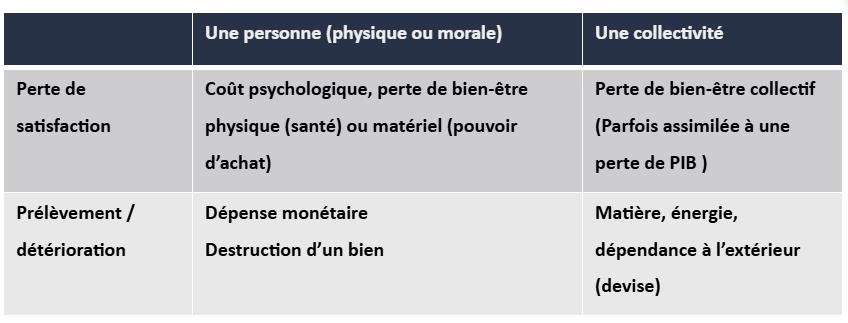
When applied to CBA, these distinctions should help avoid confusion. Are CBA costs costs for the State (or a regional authority)? Project investment costs? Cumulative discounted costs (including future operating expenses)?
Can we legitimately use economic calculations to inform decisions that are fundamentally ethical or political?
Beyond the initial criticisms of the notion of costs, there is a deeper criticism to be made of CBA. By explicitly putting a price on human life or nature, the economist gives the impression that he is outside the moral or ethical field, and is making a rational analysis. On the contrary, he is in fact pulling off an ethical and philosophical coup de force. Let’s take the example of human life. CBA is used in many fields, for example in healthcare15. The COVID crisis was the occasion for debate on this issue. Economist Christian Gollier16 with his colleague James Hammitt, for example, wrote17 Because we are not prepared to sacrifice everything to increase our life expectancy, this means that our life has a value, and that this value is finite”. The same economist used CBA to economically evaluate the containment policy during the COVID crisis18.
Admittedly, our individual and collective resources are limited, which means we have to make trade-offs between different types of expenditure, including reducing road deaths or increasing our medical capabilities. This does not mean, however, that we place a finite value on life or health, and that this value is equal to the expenditure considered.19.
As Jean-Jacques Rousseau wrote:
The politicians of old spoke incessantly of morals and virtue; our politicians speak only of trade and money. One will tell you that a man is worth as much in such and such a country as he would be sold for in Algiers; another, following this calculation, will find countries where a man is worth nothing, and others where he would be worth less than nothing. They value men like herds of cattle. According to them, a man is only worth as much to the state as he consumes in it.”20
The value we place on things and people has sentimental, emotional, philosophical, anthropological and even religious components that cannot be summed up in monetary terms. We may put an end to our lives following the death of a loved one, or go into a deep depression; none of this has anything to do with the money we’re willing to pay to reduce the risk of death linked to an infrastructure or public policy. As Aurore Lalucq and Jean Gadrey say in their bookFaut-il donner un prix à la nature ? Nature has no price, but protecting it has a cost”. When it comes to human life and health, Jean Gadrey also writes: “Human life and health have no price, but taking care of them has a cost.”21
If we accept the inescapable idea that we must provide ourselves with the means to limit the collective expenditure in question, we won’t be able to do so by resorting to such theoretical artifice in a doctoral fashion. In democracies, these deeply debatable calculations cannot replace collective deliberation, the outcome of which is not the expression of a social value made explicit by the level of expenditure decided upon, but rather, more modestly, the expenditure we are prepared to make.
The operational limits of CBA
Can we put a price on non-market quantities?
Let’s take the case of a freeway project that would divert part of the traffic from a trunk road. The expected benefits are fewer injuries and fatalities, time saved for users, decongestion of towns (when the freeway allows bypassing). These benefits are not directly monetary. The costs of the freeway are, in part: initial investment, annual operating costs and maintenance work. It also implicitly creates transfers of “land rents” (land near freeway exits increases in value, while land bordering the freeway loses value). But some of these costs are also non-monetary: the freeway artificializes the soil, encourages traffic and thereforeCO2 emissions, and is a source of noise for local residents.
To draw up a “socio-economic balance sheet” for this freeway project, we need to assign a monetary value to the non-market benefits and costs. This is what economists do. In France, official guides exist22 giving a price to a death avoided, to an hour of time saved, to a tonne ofCO2 avoided …
The first difficulty, mentioned by economist Nicolas Bouleau, is “to attribute prices to quantities that are not marketed, in particular, but not exclusively, with regard to environmental modifications.23. Economists have proposed several methods within the framework of “neo-classical welfare economics”24to evaluate intangible impacts and non-market goods. The development of environmental sciences and the sociology of public decision-making has made it clear that decisions relating to urban areas are so complex that these methods are of little use, and also that the disturbance of natural sites and water management require much more elaborate decision-making procedures.”
Nicolas Bouleau’s criticism is expressed above in terms of feasibility and reliability; it is the fragility of price estimates for non-market goods and services that he questions.
The second difficulty is more fundamental. Can we put a price on nature? We refer you to the fact sheet Should we put a price on nature, which explores this fundamental question.
Value of time, road infrastructure and speed limits.
The value of time saved is an essential determinant of the “socio-economic profitability” of freeways, but also of the CBA of a speed reduction measure. In a 2018 report on lowering the speed limit to 110 km/h on freeways, the time lost represents a cost to the community of €1,145 million. Environmental gains (less fuel, pollution andCO2) are only estimated at a benefit of 474M€.25. The balance is clearly in favor of keeping the speed limit at 130 km/h… Note, however, that the same methods lead to a different conclusion for national roads. Reducing the speed limit to 80 km/h has a generally positive socio-economic balance, due to the accidents and deaths avoided (national and departmental roads are much more dangerous than freeways).26.
These calculations are, however, questionable and disputed. Without exhausting the debate here27let’s just mention the most salient arguments. On the one hand, the speed of transport (which has increased steadily over the last 200 years, from 4 to 5 km/h to 42 km/h in 2017) has been offset by the multiplication of distances, from 4 to 44 km per person per day on average. At the individual level, speed does not save time. At the collective level, calculations of the value of time do not take into account “system effects”, such as the fact that the construction of road infrastructures creates loops of systemic interactions with urban sprawl and congestion. If everyone moves around more, rapid transit networks become saturated. New infrastructures have to be created, and so on. In the long term, with such a vicious circle, people literally lose time because of the development of speed on speed, distance on distance. In France, the average travel time to work is constantly increasing: from 20 min in 1982, to 24 min in 2018. The socio-economic evaluation of projects is incapable of integrating this type of long-term effect. It doesn’t say how it will lead people not simply to satisfy their needs, but to a definitive dependence on the car, on speed and distance – to satisfy their needs.
The economically intractable problem of choosing the right discount rate
Comparing the costs and benefits of a project is usually an intertemporal process: capital expenditure is incurred at the outset; operating expenditure and other costs and benefits are incurred throughout the life of the project, right up to its completion, and any costs of decommissioning and environmental restoration. To compare flows that do not occur at the same time, economists use a discount rate. This concept is presented in detail in the “Discount rate” fact sheet; we’ll say just a word about it here. The value chosen for this rate is decisive for the result of the calculation, and its choice is conventional. This convention cannot be based on purely economic reasoning: it necessarily involves ethical and political considerations.
CBA is only legitimate for comparisons at the margin of a reference situation.
The final difficulty is that CBA is adapted to comparisons between projects or project variants, in relation to an overall situation that is considered unchanged by the project, and therefore seen as marginal in relation to this overall situation. What is evaluated are marginal differences. Take, for example, the Montagne d’Or gold mining project in western French Guiana. 28
As economist Claude Henry writes29 :
Back in 2010, The Economist magazine, whose main concerns are not ecological, warned: “If the Amazon rainforest were to go up in smoke – a scenario that is not inconceivable with a little more clearing and a little more warming – it would spew into the atmosphere the equivalent of ten years’ worth of emissions resulting from the burning of fossil fuels.” A march to the abyss if ever there was one: it would tip us into a hostile climate without return. Considered in isolation, the Montagne d’Or project does not appear to be truly dangerous in this respect. But it makes no sense to consider it in isolation. It would be just one link in a chain of destruction running through the entire Amazon rainforest: mines, dams, legal or illegal clearing to make way for soya or cattle farming, and to appropriate the timber, arson attacks to facilitate some of these operations. The Montagne d’Or operation – on French soil and with the blessing of the French government – would provide invaluable support for all these destructive ventures and for those responsible for them. Yet the stakes involved in conserving the Amazon rainforest are such that it is now a categorical imperative (Immanuel Kant, Critique of Practical Reason). A categorical imperative does not authorize the usual political compromises, it is incompatible with the “cost-benefit” methods of evaluation customary in economic studies, nothing that violates it can be held to be marginal.”
CBA applied to public policy: the case of climate change
(See also : Global warming: what impact on growth?)
Nobel Prize-winner William Nordhaus was instrumental in perfecting this approach.30
The basic idea is to draw up a socio-economic balance sheet of the disadvantages and advantages of a policy to combat climate change. There are several ways of doing this. W. Nordhaus has drawn up economic balances for a series of warming trajectories, and deduced the economically optimal trajectory (the one with the best balance).
The economist considers that benefits and costs are measured in GDP points.31 The costs of combating climate change have an impact on GDP, but so does global warming. A macroeconomic model is therefore needed to make these assessments. W. Nordhaus developed the DICE model32 – available online – with this in mind.
The costs of global warming are assessed on the basis of a damage function, which links climate change to production losses, and therefore to GDP losses. With this logic in mind, it is possible to perform an optimization calculation to determine the optimal trajectory, the one with the best economic balance. To make this balance, which is intertemporal (costs and benefits are distributed over a long period), we need to use a discount rate(see discount rate data sheet) which compares a gain or a cost today and for each future year.
Two outputs can be derived from these calculations:
- the trajectory that optimizes the socio-economic balance ;
- the social cost of carbon corresponding to this optimum (see box below).
What is the social cost of carbon?
The social cost of carbon is equal to the welfare loss (usually discounted consumption) induced by the emission of an additional tonne of CO₂ at a given point in time.
It is evaluated in DICE (version 202333base scenario) at $175 per tonne ofCO2 in 2050 (and $66 for 2020).
The values provided for this CSC vary widely34 (from a few dozen dollars per tonne to several hundred, or even over 1,000) from one study (and model) to another, and are highly sensitive to several key parameters: the discount rate, the damage function, the inclusion of extreme risks, the time horizon, and so on.
If the CBA is the decision-making framework for climate policy, this CCS is a reference for positioning theCO2 “marginal abatement costs” of the various conceivable actions to reduce emissions. Marginal abatement cost35 measures the cost of not emitting a tonne of CO2 (insulating a building, installing a low-carbon energy source, switching to electric propulsion (for cars and trucks), capturing CO₂…).
Note that this approach has not been adopted for France, where the value of climate action, estimated by the Quinet commissions (which aims to give a reference to abatement costs) is derived from a cost-effectiveness calculation(see next box).
What do these works conclude? Antonin Pottier36 In the arguments of the juries for the Bank of Sweden prize, we find a graph showing the “optimal” trajectory ofCO2 emissions according to Nordhaus, a trajectory that goes from 35 GtCO2 per year in 2015 to around 15 GtCO2 at the end of the century. It takes a little research to realize that Nordhaus’ optimal solution leads to a warming of… 3.5°C in 2100. Hardly a slight change from the 4°C of the no-action scenario!
Nordhaus’ work has been severely criticized, notably by economist Steve Keen37. To sum up, the main problems with this type of exercise are as follows:
- Expressing the outcome of a policy in GDP points (or in utility derived from consumption) is ethically questionable. The underlying logic of the neoclassical school of economics thus poses a fundamental problem: it is deeply questionable to make the maximization of the “utility” (see The Other Economy ‘s fact sheet on utility) that consumers derive from their incomes the basis of a policy.38 as the criterion for social well-being.
- we don’t actually know how to assess the socio-economic consequences of climate change.
The effects of climate change are very heterogeneously distributed, both geographically and socially, and it is impossible to reason as if the losses of some offset the possible benefits of others in the absence of redistribution mechanisms. Moreover, they are “non-linear”, and tipping points can occur.39. More pragmatically, past observations on the costs of climate change cannot be used as a basis for assessing what they will be in the future, due to this non-linearity.
- inter-temporal comparisons are made using a de facto arbitrary discount rate40 as soon as it is positive, it weakens the weight of long-term costs and benefits. This has the effect of minimizing the effects of climate change, and raises major ethical issues (the relative weight of present and future generations in the decision) that cannot be summed up in a single figure.
- macroeconomic models have not proven their ability to represent the economy and its evolution, especially over the long term. In particular, GDP growth in these models is determined to first order by exogenous labor productivity growth.
All in all, it’s clearly a sham. Mathematical formalism and the words of physical science are being used in a field where experimentation is either impossible or non-existent, while camouflaging eminently questionable ethical choices.
Cost-effectiveness analysis
Economists have developed a less ambitious approach than the one presented above, but still based on cost-benefit analysis. Instead of comparing different warming trajectories in an attempt to deduce an optimal one, they seek to determine economic trajectories that respect a given climate constraint, i.e. limiting greenhouse gas emissions. In France, these studies were carried out in 200941, 201942 and 2024-202543 in expert commissions chaired by economist Alain Quinet.
Here too, the use of economic models to represent the French economy and its evolution over time is essential. The result of this work translates into a value: that of climate action, also known as the tutelary value of carbon. The idea is to give carbon a value (increasing over time) whose multiplication by the quantities of GHGs avoided would be equal to the loss of GDP induced by the constraint. If this value were to be applied throughout the economy by emitting economic agents, via a carbon tax of an equivalent amount, these agents would limit their emissions to limit their loss of income to the “socially optimal” level. For economists who have confidence in this method, this value of climate action is therefore an essential benchmark: it would be optimal to carry out all actions whose cost per tonne ofCO2 avoided would be lower (for a given year) than this value of climate action, and inefficient to carry out those whose cost per tonne ofCO2 avoided would be higher. And it would be desirable to set a carbon tax at the level of this value (but in this case by removing any regulation or constraint that might generate other costs for the players)? In a word, once this price is established in the economy, all the players will follow. Desirable investments will be made, and there will be no need for public spending to play another role.
However, the figures used for this value in 2025 are high: 300 euros per tonne ofCO2 in 2030 rising to 563 euros in 2050.44 They pose fundamental problems: if this value were adopted as the level of the carbon tax (i.e., in 2030, an increase in the price of a liter of petrol compared with today of around 50 € cents), it would be necessary to increase the price of a litre of petrol.45 then an increase from 2030 to 2050 of around €60 cents) would clearly be socially unacceptable. 46
These calculations are useful, as they enable us to visualize the scale of the transformation required to meet the climate constraint. They are, however, questionable: the models are highly simplified models of the economy, they must use an arbitrary discount rate, the impact of climate change on the economy is poorly represented or not represented at all, the effects of redistribution between economic agents are not represented at all, and so on. More fundamentally, as in the previous case, they consider that the function to be optimized is GDP (or the average income of economic agents), which is highly debatable.
Conclusion
In conclusion, CBA is useful in well-defined cases. It enables us to objectivize the terms of the debates necessary in a democracy, to study projects and especially variants between projects whose socio-economic impact is limited. By highlighting the positive and negative consequences of a project for stakeholders, the terms of these debates can be clearly defined. Their monetization, in the case of impacts on Nature, is far more debatable, as is the use of a single aggregate indicator.
We need new tools for reasoning in the face of the climate and ecological crisis we are experiencing. If we need to limit our public spending, because trees don’t grow on trees, we can’t do it by drawing up accounting balance sheets based on conventions, however elaborate they may be.
Shouldn’t we therefore adopt stricter rules based on the carbon budgets that the French government has defined for the coming years? Should we not simply abandon projects that do not reduce the GHG emissions of the activities concerned, or whose impacts on biodiversity are clearly out of proportion?
We need new methods which, without denying the importance of budgetary trade-offs, make them conditional on consideration of non-negotiable planetary limits. This is the case with so-called “robust” approaches. 47
- An analysis by the Secrétariat Général Pour l’Investissement in 2020 shows an inventory of 1,170 projects identified since 2013 for a total of €378 billion. This is not a marginal number. ↩︎
- As part of the implementation of the REACH directive on chemicals, manufacturers have put forward such analyses to ensure that certain molecules toxic to humans are not banned. See the website of the European Chemicals Agency, ECHA. ↩︎
- The French National Authority for Health (HAS) has produced a methodological guide on the subject. The French Social Security Financing Act for 2008 conferred competence on the HAS in the field of economic evaluation: “as part of its missions, the HAS issues medico-economic recommendations and opinions on the most efficient care, prescription or management strategies” (article 41). ↩︎
- See Guide de l’évaluation socioéconomique des investissements publics, published by the Haut commissariat à la stratégie et au plan. ↩︎
- See the different guides :
Guide to Cost-Benefit Analysis of Investment Projects for Cohesion Policy 2014-2020;
Economic Appraisal Vademecum 2021-2027 – General Principles and Sector Applications;
Economic appraisal. Vademecum 2021-2027. ↩︎ - On the OECD website, see the document Analyse coûts-avantages et environnement: Avancées théoriques et utilisation par les pouvoirs publics. ↩︎
- Net present value (NPV) is a measure of the profitability of an investment, calculated as the sum of the cash flows generated by the operation, each discounted to present value. See the discount rate sheet. See also the Fipeco sheet on the subject. ↩︎
- View the original article by Jules Dupuy Measuring the usefulness of public works. ↩︎
- Law no. 2012-15581 of December 31, 2012 on multi-annual programming of public finances, requires a prior socio-economic assessment for all civil investment projects financed by the State, its public establishments, public health establishments or health cooperation structures. For further details, see the guides cited in note 5. ↩︎
- The decree implementing the above-mentioned law entrusts the procedure to the SGPI (Secrétariat Général pour l’Investissement – General Secretariat for Investment), which is required to carry out an annual survey of all projects under consideration for which state funding exceeds the €20 million threshold. In addition, for any project whose funding exceeds €100 million, the SGPI organizes an independent counter-expertise of the socio-economic assessment file and issues an opinion. ↩︎
- See Socio-economic and financial assessment. ↩︎
- See Review of the Social Cost-Benefit Analysis of Grand Ouest Airport. Delft, 2011 ↩︎
- See this post by lawyer Arnaud Gossement: Autoroute A 69 : un projet autorisé au titre du code de l’environnement, critiqué au nom de la protection de l’environnement. ↩︎
- See Socio-economic assessment of major state investments. Variances, June 2020. ↩︎
- See, for example, Anne Crochard-Lacour, Jacques LeLorier Introduction to pharmacoeconomics . See also for the case of air quality : Olivier Chanel, Aurore Basiuk. How much is cleaner air worth?, 2021. ↩︎
- Former Director General of the Toulouse School of Economics, author of numerous articles and books, including Economie de l'(in)action climatique, PUF, 2025, which promotes CBA. ↩︎
- Coronavirus: “We are not prepared to sacrifice everything to increase our life expectancy”.. ↩︎
- Cost-benefit analysis of deconfinement strategies. TSE.Policy brief. 2020. ↩︎
- See this article by Jean Barfety: Coronavirus: “Life is not the sum of financial flows, and the legislator will not stoop to formalizing the contrary”.. ↩︎
- Jean-Jacques Rousseau, Discours sur les sciences et les arts, Paris, Flammarion, Le Monde de la philosophie, 2008, p. 28. ↩︎
- In this article: Economists who would like to manage the health crisis according to the price of human life and GDP ↩︎
- See the different guides :
Guide to Cost-Benefit Analysis of Investment Projects for Cohesion Policy 2014-2020 ;
Economic Appraisal Vademecum 2021-2027 – General Principles and Sector Applications ;
Economic appraisal. Vademecum 2021-2027. ↩︎ - See also ↩︎
- See section: Should we put a price on nature? ↩︎
- CGDD, 2018. Reducing road speeds. Cost-benefit analysis , p. 38. ↩︎
- See the book cited by Christian Gollier, “Économie de l'(in)action climatique” (PUF), 2025. ↩︎
- See, for example, this article by Emmanuel Munch. New highways and the myth of time savings. HAL Id: hal-04491880. 2024. ↩︎
- See this FNE dossier Montagne d’Or in French Guiana: a destructive mining project for the Amazon rainforestconsulted on February 12, 2026. ↩︎
- Text written in 2019, for a draft open letter to the President of the Republic. Personal documentation. ↩︎
- In 2006, economist Nicholas Stern also quantified and publicized the “cost of inaction” on climate change. See The Economics of Climate Change: The Stern Review. London School of Economics. 2006. ↩︎
- Technically, it’s a little more complex: the economist uses utility functions, which are functions of consumption, itself linked to the production function. The choice of utility function, which is largely arbitrary and often made for mathematical reasons, does not, however, have a neutral impact on the conclusions. ↩︎
- See Pierre Matarasso. Presentation of two emblematic models for analyzing the economic policies of climate change: MARKAL and DICE.. 2003. and see the DI CE model documentation online. For an introduction to the model, see a very clear paper by Kathleen Schubert:Nordhaus: Integrating climate change into long-term macroeconomic analysisRevue d’économie politique, Dalloz. 2019. ↩︎
- See this article by Lint Barrage & William Nordhaus.“Policies, projections, and the social cost of carbon: Results from the DICE-2023 model,” Proceedings of the National Academy of Sciences. 2024. ↩︎
- See, for example, this study by Rennert et al:The Social Cost of Carbon: Advances in Long-Term Probabilistic Projections of Population, GDP, Emissions, and Discount Rate. ↩︎
- For France, see this summary of a major study on abatement costs in France. 2023. ↩︎
- In the article Climate: is William Nordhaus really serious? Alternatives économiques. Oct. 2018. ↩︎
- See this translation of his article published in 2019 on the Mint Magazine Nordhaus’s Nobel Prize is not under threat: our world is. ↩︎
- To understand the link between these notions, we need to remember that GDP can be understood as the sum of a country’s “domestic” income. See the “Growth, GDP and planetary limits” module ↩︎
- See The global tipping points report 2025. See also the post Tipping points, power laws and the climate economy – Anthropocene Chronicles, February 2025 ↩︎
- There is no consensus among economists on which rate to use, and the choice has an ethical, and therefore political, component that cannot be ignored. ↩︎
- See the report : The Guardian Value of Carbon, 2009. ↩︎
- See the report : The value of climate action, 2019. ↩︎
- See the report : The value of climate action. A benchmark for assessment and action , 2025. ↩︎
- The constraint to be respected in these calculations is that of France’s carbon neutrality by 2050. ↩︎
- A liter of gasoline emits 2.3Kg ofCO2. The current carbon tax is 45 euros per tonne ofCO2, which corresponds to around 10 € cents per liter. 200 euros more is about €45 cents more. ↩︎
- People react very differently to a rise in the price of fossil fuels set by the markets and to a tax increase decided by a government. In the first case, they are rather fatalistic and adapt as far as possible. In the second, they revolt against the government, as in the episode of the yellow vests, in France, at the end of 2018. Note that the rise in petrol prices due to the carbon tax was in fact only €2 cents over 2018. But it was concomitant with a much more significant rise in the market price, with the price of a barrel rising by 30% between 2017 and 2018. ↩︎
- View post Nature at the heart of economic reasoning: the emergence of a new macroeconomics. See also the post Tipping points, power laws and climate economics – Anthropocene Chronicles, February 2025 ↩︎